
English
Services
This page follows a row on the Services page from its source to its button in a client window. It ends with declaring a row by hand. The badge on the page reads the healthy count against the total, 3 of 4 healthy for example.
Kinds and buttons
| Kind | Group on the page | Where it comes from | The client's button |
|---|---|---|---|
| Web | Web | the Gitea module, or a declaration | Open |
| Ports | Ports | a container's published port, or a declaration | Connect |
| AI | AI | the hub's AI gateway | Config, then Apply |
| Files | Files | the Samba module, or a declaration | Config, then Mount |
| Remote desktops | none | a machine sharing its own desktop | Connect |


The page has four groups; a shared desktop is listed on clients and in the machine's drawer only. A row shows whether the source is serving or not serving and whether the hub finds it reachable or unreachable. A chip reads module when a module published the row and declared when a declaration did.
Discovered entries
A module enabled on a device publishes without a declaration. The Samba module publishes each share as published by the samba module on that host. The Gitea module publishes its address, and a container publishes each host port it exposes. The hub's AI gateway publishes its endpoint. A machine publishes its desktop while sudo nagent rdp start is running on it; the entry disappears when the share stops.
Declare a service by hand
A declaration publishes something the hub does not manage: a web page, a TCP port, or an SMB share on another server.
- Select Declare service.
- Fill Name and pick the Kind: Web, Port or File.
- Fill Host and Port; a web kind adds a scheme and a path, and a file kind takes
445when the port is left blank. - For a file kind, type a share name, or select Scan host to list the server's shares; each listed share is published as its own row.
- Select Declare.

A host of 127.0.0.1, 0.0.0.0, ::1 or localhost means the hub itself, and each machine receives it as the address it reaches the hub on. Test probes a declared row, and Delete removes the declaration with every row it published; the machine it points at is untouched.
Each kind in the client
| Panel | What the button does |
|---|---|
| Web | Open opens the link in the default browser. |
| Ports | Connect relays the port to 127.0.0.1 on the computer; Disconnect closes the relay. |
| AI | Config picks the models per tool, Apply points the tools at the gateway or restores them. |
| Files | Config takes the share's login and a path or drive letter, Mount attaches it, Unmount detaches it. |
| Remote desktops | Connect opens the RustDesk viewer on that desktop. |
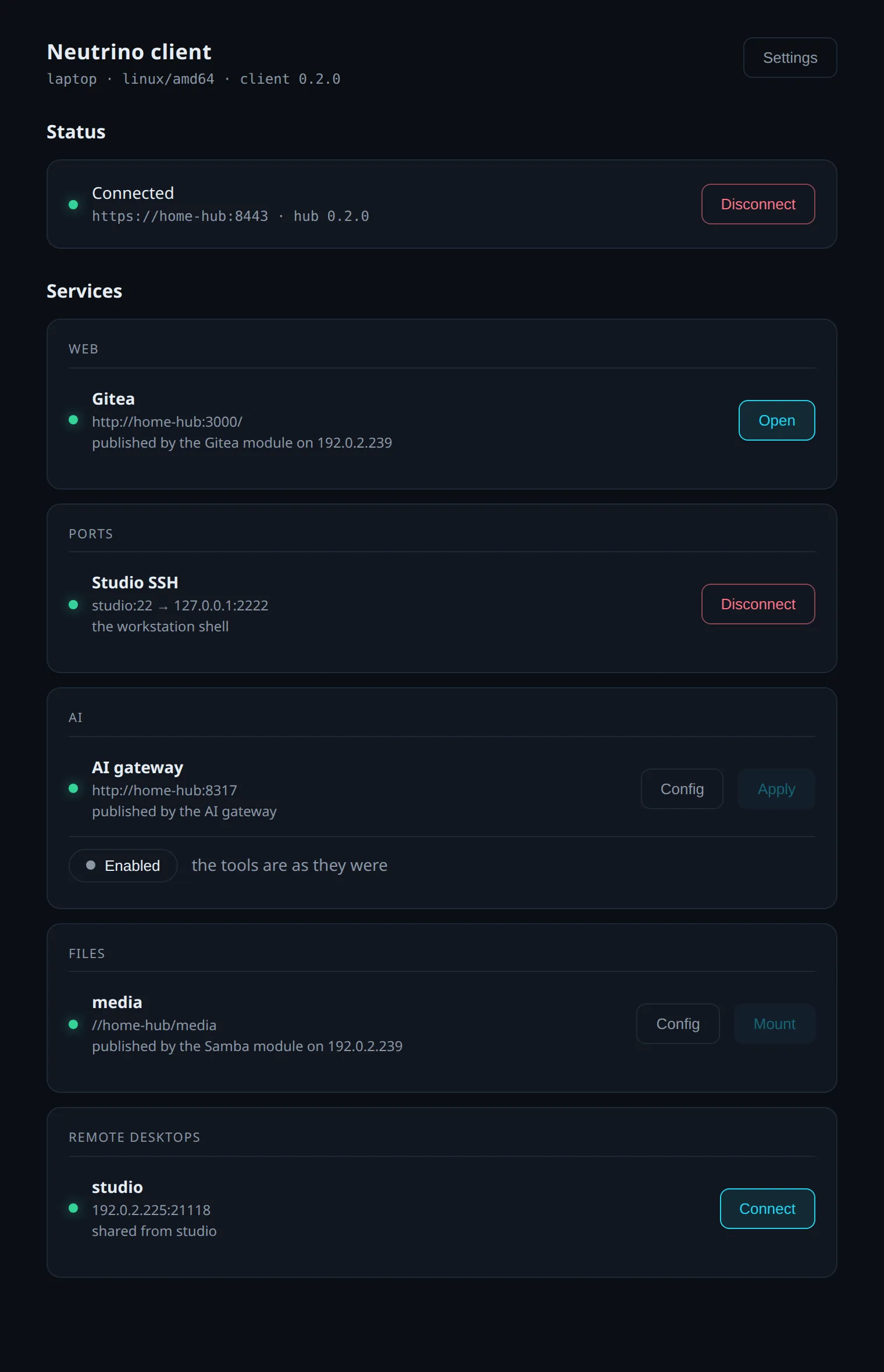


An unreachable row is greyed in the client and reads not reachable now. Each panel has a page of its own under Client in the sidebar.
What the agent provides
The pages under Agent each enable one capability on a managed machine, and the pages that publish do so through the groups on this page:
| Page | What it does on a machine |
|---|---|
| Terminals | opens a root shell, in tabs |
| Files | browses, uploads, downloads and moves files |
| Samba | serves SMB shares, published under Files |
| Gitea | runs a private git server, published under Web |
| Containers | runs declared containers, their host ports published under Ports |
| ZFS | builds pools and datasets, and shares a dataset through Samba |