
English
Credentials
SSH keys, logins and tokens are written once on the Credentials page and read by the pages that sign in with them. This page covers what the Credentials page holds, how the vault seals it, and what a lost passphrase costs.
SSH keys, logins and tokens
| Kind | What it holds | Added with |
|---|---|---|
| SSH keys | a private key, and its passphrase when the key is encrypted | Add key, the whole key pasted with its BEGIN and END lines |
| Logins | a username and password pair, or a bare password | Add login |
| Tokens | a single secret value under a name | Add token |
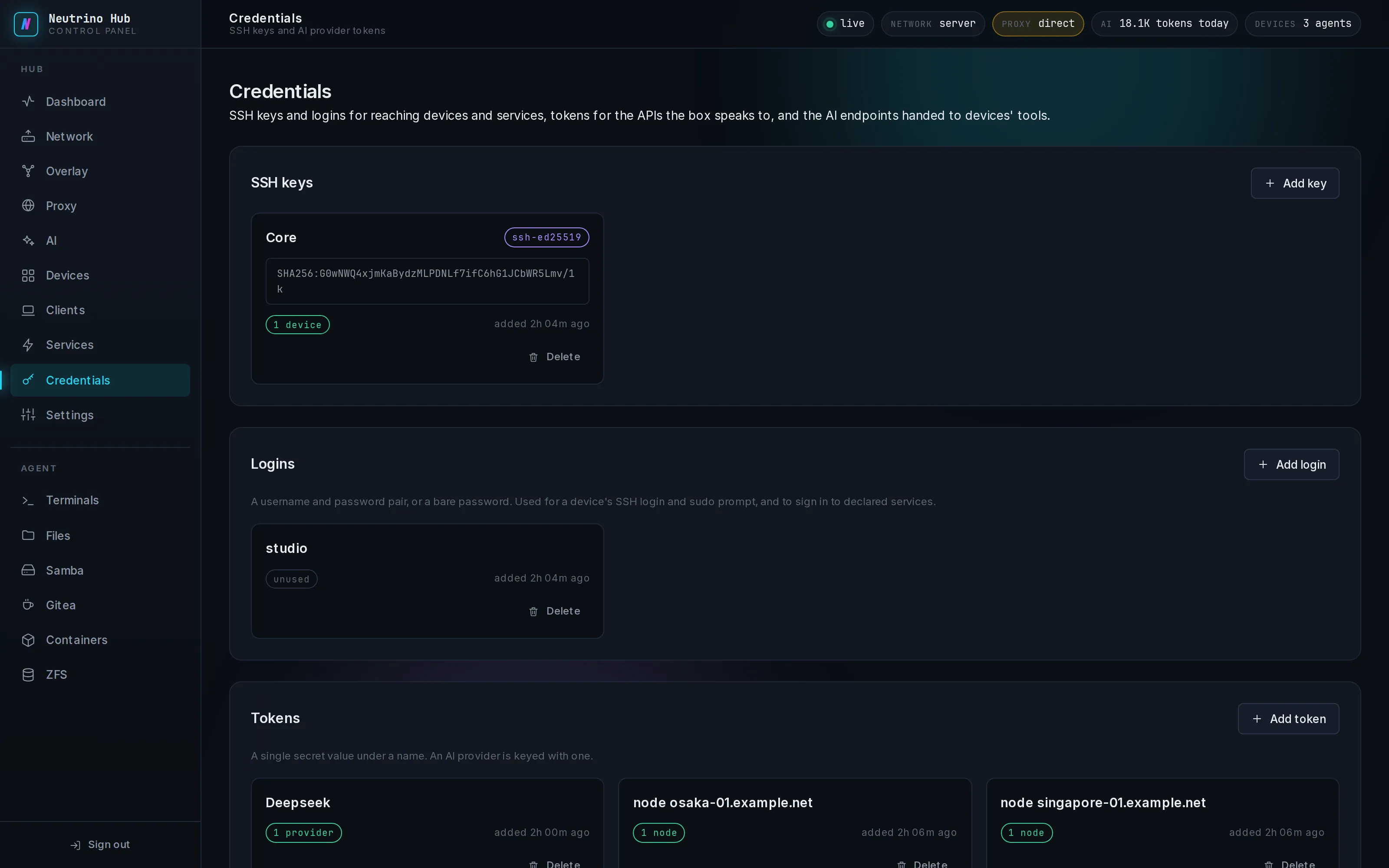
Every entry is write-only: the page shows names and kinds, and a value is never shown again after it is saved. The hub rejects a public key with key_is_public, because it needs the matching private key. It rejects an encrypted key without its passphrase with key_passphrase_needed.
Who uses them
You pick a credential on the page that signs in with it. Install agent on the Devices page picks an SSH key or a login for the machine, and a login for sudo there. A provider on the AI page is keyed with a token, and a proxy node with a token where its link has one. The delete confirmation counts what loses the entry. A device or a provider that loses its credential needs a new one, and a node that loses its token is disabled.
The vault
The vault is the file under config/ that holds every value. A data key encrypts the values together with their names and kinds. The data key is itself sealed under the master passphrase set on the wizard's second screen. A backup of config/ therefore holds ciphertext, and a restore of it requires the same passphrase.
Rekey and a lost passphrase
sudo nhub vault rekey wraps the data key under a new passphrase, and nothing sealed is re-encrypted. An archive downloaded before the rekey still opens with the passphrase it was taken under.
DANGER
The passphrase is the one key to the vault. A lost passphrase means the vault's contents are gone, and every credential and AI account is entered again.